
Rate Limiting Pattern in Java: Controlling System Overload Gracefully
Also known as
- Throttling
- Request Limiting
- API Rate Limiting
Intent of Rate Limiting Design Pattern
To regulate the number of requests sent to a service in a specific time window, avoiding resource exhaustion and ensuring system stability. This is especially useful in distributed and cloud-native architectures.
Detailed Explanation of Rate Limiting with Real-World Examples
Real-world example
Imagine you're entering a concert hall that only allows 50 people per minute. If too many fans arrive at once, the gate staff slows down entry, allowing only a few at a time. This prevents overcrowding and ensures safety. Similarly, the rate limiter controls how many requests are processed to avoid overloading a server.
In plain words
Regulate the number of requests a system handles within a time frame to protect availability and performance.
AWS says
"API Gateway limits the steady-state rate and burst rate of requests that it allows for each method in your REST APIs. When request rates exceed these limits, API Gateway begins to throttle requests."
— API Gateway quotas and important notes - AWS Documentation
Architecture Diagram
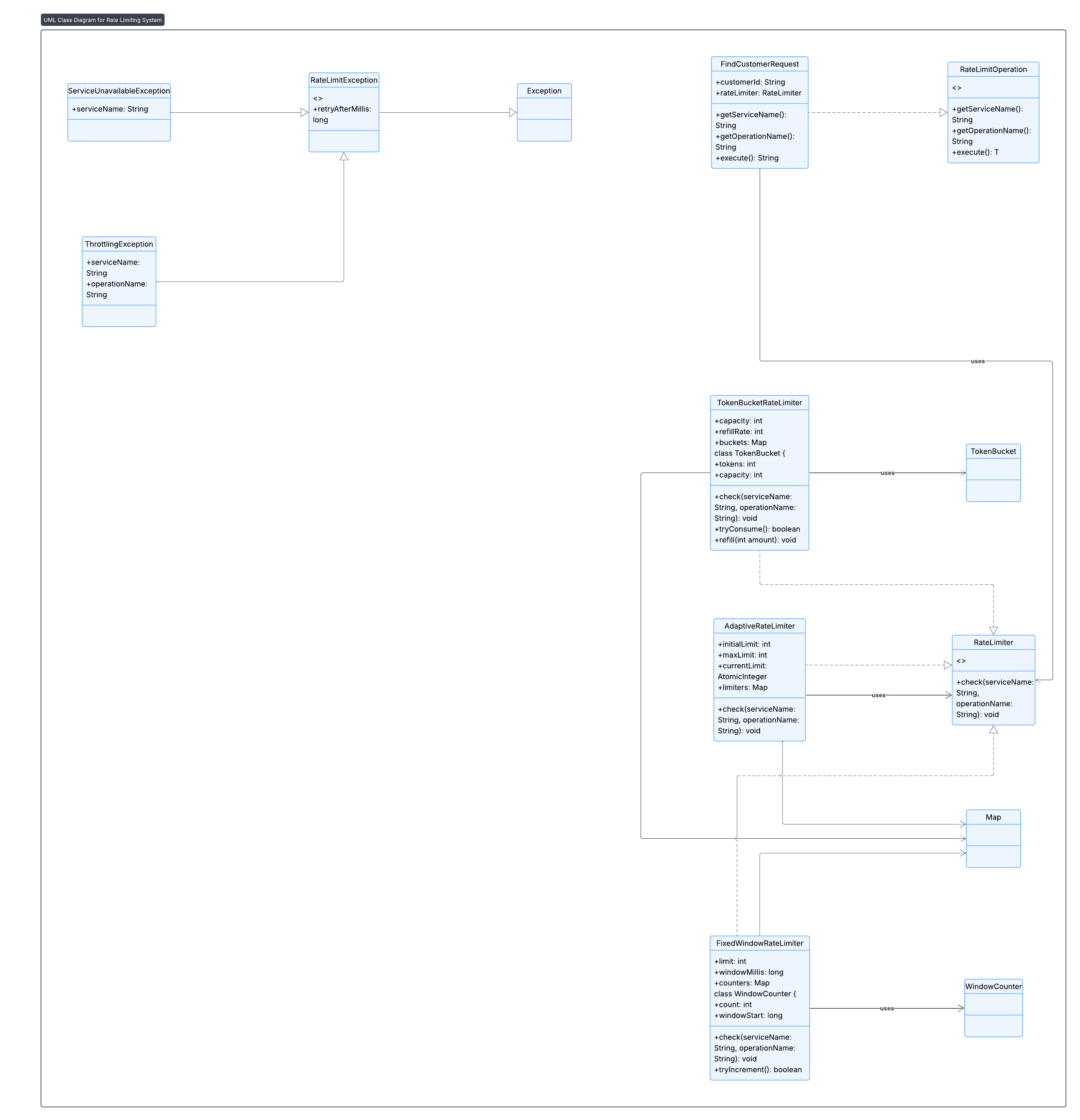
This UML shows the key components:
RateLimiterinterfaceTokenBucketRateLimiter,FixedWindowRateLimiter,AdaptiveRateLimiter- Supporting exception classes
FindCustomerRequestas a rate-limited operation
Flowcharts
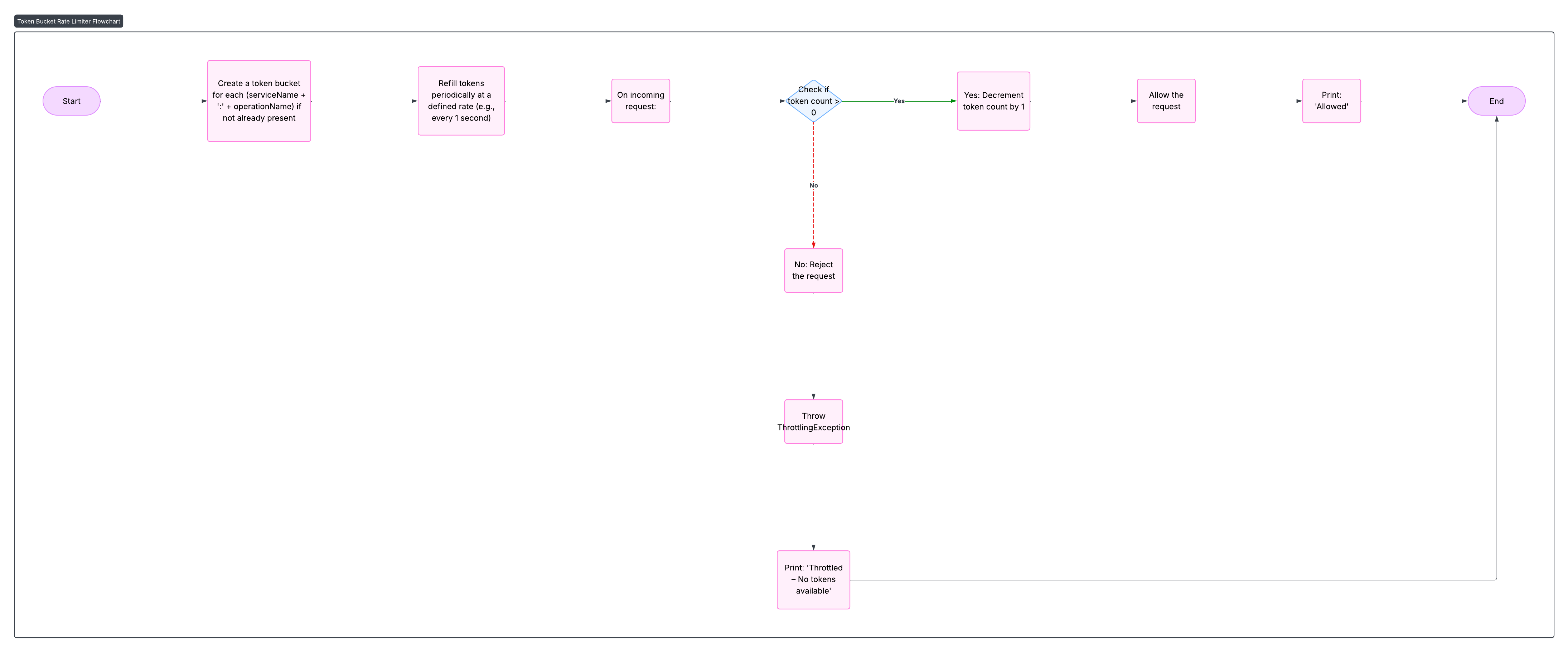
1. Token Bucket Strategy
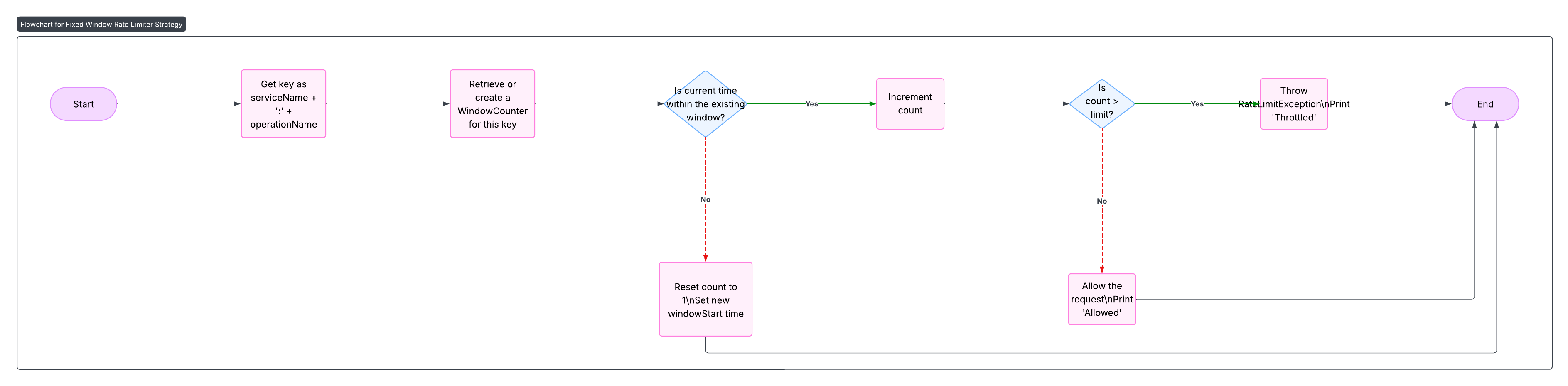
2. Fixed Window Strategy
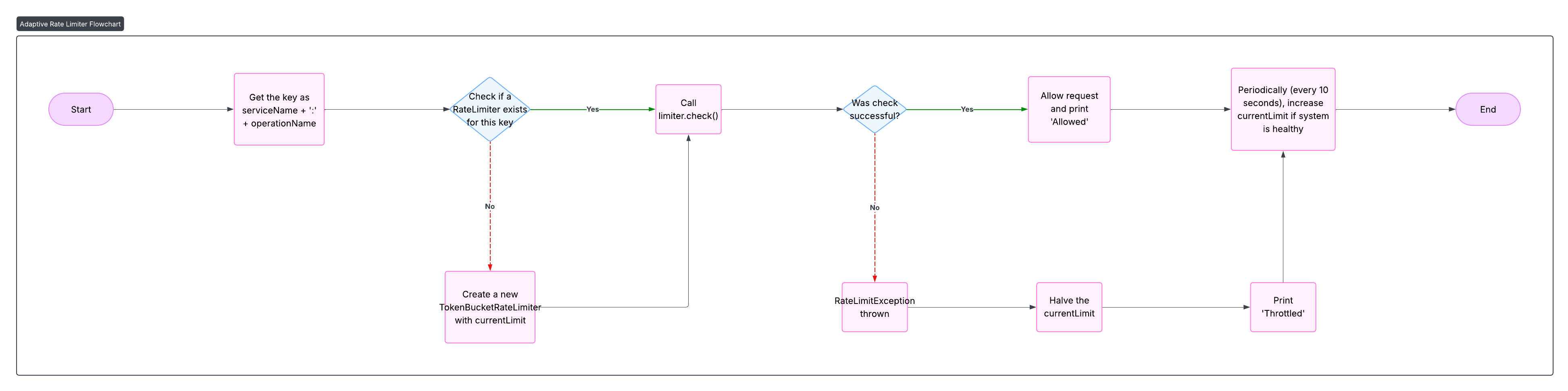
3. Adaptive Rate Limiting Strategy
Programmatic Example of Rate Limiter Pattern in Java
The Rate Limiter design pattern helps protect systems from overload by restricting the number of operations that can be performed in a given time window. It is especially useful when accessing shared resources, APIs, or services that are sensitive to spikes in traffic.
This implementation demonstrates three strategies for rate limiting:
- Token Bucket Rate Limiter
- Fixed Window Rate Limiter
- Adaptive Rate Limiter
Let’s walk through the key components.
1. Token Bucket Rate Limiter
The token bucket allows short bursts followed by a steady rate. Tokens are added periodically and requests are only allowed if a token is available.
public class TokenBucketRateLimiter implements RateLimiter {
  private final int capacity;
  private final int refillRate;
  private final ConcurrentHashMap<String, TokenBucket> buckets = new ConcurrentHashMap<>();
  private final ScheduledExecutorService scheduler = Executors.newScheduledThreadPool(1);

  public TokenBucketRateLimiter(int capacity, int refillRate) {
    this.capacity = capacity;
    this.refillRate = refillRate;
    scheduler.scheduleAtFixedRate(this::refillBuckets, 1, 1, TimeUnit.SECONDS);
  }

  @Override
  public void check(String serviceName, String operationName) throws RateLimitException {
    String key = serviceName + ":" + operationName;
    TokenBucket bucket = buckets.computeIfAbsent(key, k -> new TokenBucket(capacity));
    if (!bucket.tryConsume()) {
      throw new ThrottlingException(serviceName, operationName, 1000);
    }
  }

  private void refillBuckets() {
    buckets.forEach((k, b) -> b.refill(refillRate));
  }

  private static class TokenBucket {
    private final int capacity;
    private final AtomicInteger tokens;

    TokenBucket(int capacity) {
      this.capacity = capacity;
      this.tokens = new AtomicInteger(capacity);
    }

    boolean tryConsume() {
      while (true) {
        int current = tokens.get();
        if (current <= 0) return false;
        if (tokens.compareAndSet(current, current - 1)) return true;
      }
    }

    void refill(int amount) {
      tokens.getAndUpdate(current -> Math.min(current + amount, capacity));
    }
  }
}
2. Fixed Window Rate Limiter
This strategy uses a simple counter within a fixed time window.
public class FixedWindowRateLimiter implements RateLimiter {
  private final int limit;
  private final long windowMillis;
  private final ConcurrentHashMap<String, WindowCounter> counters = new ConcurrentHashMap<>();

  public FixedWindowRateLimiter(int limit, long windowSeconds) {
    this.limit = limit;
    this.windowMillis = TimeUnit.SECONDS.toMillis(windowSeconds);
  }

  @Override
  public synchronized void check(String serviceName, String operationName) throws RateLimitException {
    String key = serviceName + ":" + operationName;
    WindowCounter counter = counters.computeIfAbsent(key, k -> new WindowCounter());

    if (!counter.tryIncrement()) {
      throw new RateLimitException("Rate limit exceeded for " + key, windowMillis);
    }
  }

  private class WindowCounter {
    private AtomicInteger count = new AtomicInteger(0);
    private volatile long windowStart = System.currentTimeMillis();

    synchronized boolean tryIncrement() {
      long now = System.currentTimeMillis();
      if (now - windowStart > windowMillis) {
        count.set(0);
        windowStart = now;
      }
      return count.incrementAndGet() <= limit;
    }
  }
}
3. Adaptive Rate Limiter
This version adjusts the rate based on system health, reducing the rate when throttling occurs and recovering periodically.
public class AdaptiveRateLimiter implements RateLimiter {
  private final int initialLimit;
  private final int maxLimit;
  private final AtomicInteger currentLimit;
  private final ConcurrentHashMap<String, RateLimiter> limiters = new ConcurrentHashMap<>();
  private final ScheduledExecutorService healthChecker = Executors.newScheduledThreadPool(1);

  public AdaptiveRateLimiter(int initialLimit, int maxLimit) {
    this.initialLimit = initialLimit;
    this.maxLimit = maxLimit;
    this.currentLimit = new AtomicInteger(initialLimit);
    healthChecker.scheduleAtFixedRate(this::adjustLimits, 10, 10, TimeUnit.SECONDS);
  }

  @Override
  public void check(String serviceName, String operationName) throws RateLimitException {
    String key = serviceName + ":" + operationName;
    int current = currentLimit.get();
    RateLimiter limiter = limiters.computeIfAbsent(key, k -> new TokenBucketRateLimiter(current, current));

    try {
      limiter.check(serviceName, operationName);
    } catch (RateLimitException e) {
      currentLimit.updateAndGet(curr -> Math.max(initialLimit, curr / 2));
      throw e;
    }
  }

  private void adjustLimits() {
    currentLimit.updateAndGet(curr -> Math.min(maxLimit, curr + (initialLimit / 2)));
  }
}
4. Simulated Demo Using All Limiters
public final class App {
  public static void main(String[] args) {
    TokenBucketRateLimiter tb = new TokenBucketRateLimiter(2, 1);
    FixedWindowRateLimiter fw = new FixedWindowRateLimiter(3, 1);
    AdaptiveRateLimiter ar = new AdaptiveRateLimiter(2, 6);

    ExecutorService executor = Executors.newFixedThreadPool(3);
    for (int i = 1; i <= 3; i++) {
      executor.submit(createClientTask(i, tb, fw, ar));
    }
  }

  private static Runnable createClientTask(int clientId, RateLimiter tb, RateLimiter fw, RateLimiter ar) {
    return () -> {
      String[] services = {"s3", "dynamodb", "lambda"};
      String[] operations = {"GetObject", "PutObject", "Query", "Scan", "PutItem", "Invoke", "ListFunctions"};
      Random random = new Random();

      while (true) {
        String service = services[random.nextInt(services.length)];
        String operation = operations[random.nextInt(operations.length)];
        try {
          switch (service) {
            case "s3" -> tb.check(service, operation);
            case "dynamodb" -> fw.check(service, operation);
            case "lambda" -> ar.check(service, operation);
          }
          System.out.printf("Client %d: %s.%s - ALLOWED%n", clientId, service, operation);
        } catch (RateLimitException e) {
          System.out.printf("Client %d: %s.%s - THROTTLED%n", clientId, service, operation);
        }

        try {
          Thread.sleep(30 + random.nextInt(50));
        } catch (InterruptedException e) {
          Thread.currentThread().interrupt();
        }
      }
    };
  }
}
This example highlights how the Rate Limiter pattern supports various throttling techniques and how they respond under simulated traffic pressure, making it invaluable for building scalable, resilient systems.
When to Use Rate Limiting
- APIs receiving unpredictable traffic
- Shared cloud resources (e.g., DB, compute)
- Services requiring fair client usage
- Preventing DoS or abuse
Real-World Applications
- AWS API Gateway
- Google Cloud Functions
- Netflix Zuul API Gateway
- Stripe API Throttling
Benefits and Trade-offs
Benefits
- Protects backend from overload
- Fair distribution of resources
- Better user experience under load
Trade-offs
- May delay valid requests
- Requires tuning of limits
- Could create bottlenecks if misused
Related Java Design Patterns
References and Credits
- Microsoft Cloud Design Patterns
- AWS API Gateway Throttling
- Designing Data-Intensive Applications by Martin Kleppmann
- Resilience4j
- Java Design Patterns Project: java-design-patterns